In short
- Rails must be fixed firmly into a wall that can take your weight.
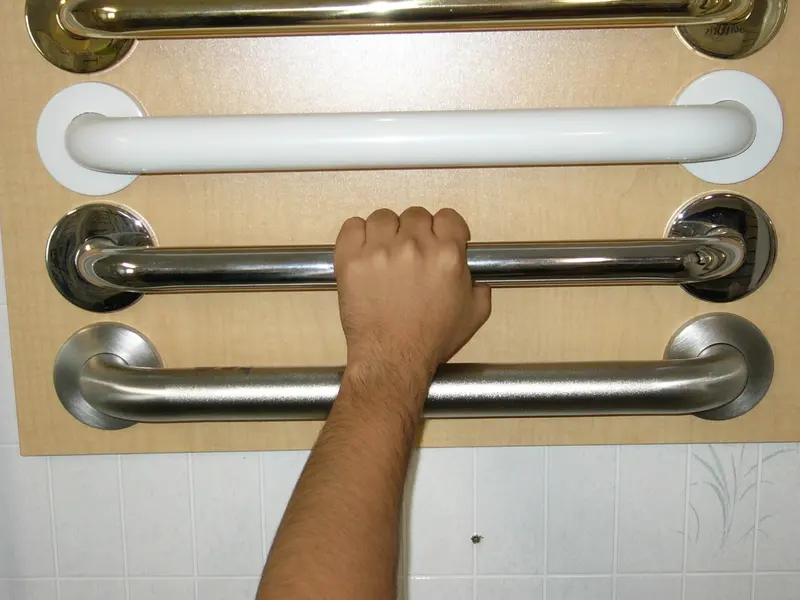
- Choose rails with a ribbed or textured grip, so they are not slippery when wet.
- Never use taps or heated towel rails as grab rails. They are not made to take your weight.
- An occupational therapist can work out the best positions for you.
- In England, grab rails are one of the examples of small adaptations the council must provide free if your assessment shows you need them.
Why grab rails help
The NHS advice on preventing falls includes fitting "grab rails in the bathroom". A rail gives you something firm to hold when you:
- step into or out of the bath or shower
- sit down on, or get up from, the toilet
- lower yourself onto a shower seat
What to look for
- A good grip. Living Made Easy says bathroom rails "should have a ribbed or textured surface to give extra grip when wet".
- Space for your hand. It says there should be a gap of 50mm to 60mm between the wall and the rail.
- The right length for where it will go. Vertical rails help you pull up. Horizontal rails help you steady yourself and push up.
- A colour you can see. A rail that stands out from the wall is easier to find, especially if your eyesight is not good.
Where rails often go
Every person and bathroom is different, so ask an occupational therapist to decide the positions. As an example, Living Made Easy gives these positions for a bath:
- a horizontal rail 75mm to 100mm above the bath rim, starting 200mm from the tap end
- a vertical rail at least 500mm long, 600mm from the tap end, with its lower end 200mm above the bath rim
For a shower seat, it gives an example of a rail on the side wall about 200mm above the seat.
Fixing rails safely
A rail is only as safe as its fixings.
- Rails must be fixed into a wall strong enough to take your weight. Living Made Easy says a bath next to a solid wall makes rails more secure.
- NHS inform advises making sure rails anywhere in the bathroom "are attached to the wall securely".
- Rails that clamp onto the side of a bath need checking often and tightening when needed. Living Made Easy does not recommend them for plastic (acrylic) baths, because the bath may crack.
Never pull yourself up on a tap or a heated towel rail. Living Made Easy says most taps "will not be strong enough to withstand a person's weight", and heated towel rails are not designed to give support and can burn you.
Getting grab rails
- In England, the NHS gives "grab rails for the bathroom" as an example of the small changes that are free if a council assessment shows you need them. Free aids and small adaptations.
- In Wales, the ENABLE scheme lists grab rails as a "small" adaptation.
- In Northern Ireland, small adaptations such as handrails may be available from your Health and Social Care Trust after an occupational therapy assessment.
- In Scotland, small items such as grab rails are handled separately from grants for major adaptations — ask your council's social work team.
- If you are 60 or over and pay for grab rails to be supplied and fitted, the VAT is 5%. VAT relief.
See grab rails in our bathroom aids list.
Bathroom aids to look at
- Wall-fixed grab rail (Grab rails)
- Bath-side rail (clamps onto the bath) (Grab rails)
Sources we checked
- Living Made Easy: Bath lifts and hoists (bath rails) (opens another website)
- Living Made Easy: Showers (rails next to shower seats) (opens another website)
- Living Made Easy: Adapting your home – the bathroom (factsheet) (opens another website)
- NHS: Falls (opens another website)
- NHS inform: Prevent falls by doing a home safety check (opens another website)
- NHS: Care and support you can get for free (opens another website)
- GOV.UK: VAT on mobility aids (5% for people aged 60 or over) (opens another website)
We last checked these sources on 3 October 2026. Rules and amounts can change, so please check with the organisation before you rely on them.
Get an assessment first
An occupational therapist (OT) can visit you at home and recommend what is safe and suitable for you. Ask your council’s adult social care team — in Northern Ireland, your Health and Social Care Trust.
This guide is general information, not medical, financial or legal advice. Everyone’s needs are different. Speak to an occupational therapist, your GP or the organisations we link to before making decisions.