Some families like to give practical presents to older relatives — something that makes daily life a little easier. Small bathroom aids can be thoughtful gifts. But some aids need to be chosen and fitted with care, and some may be available free after an assessment.
This article sorts the simple gifts from the ones to check first. It is general information; we don't test or rate products and don't recommend particular brands. An occupational therapist (OT) is the right person to advise on what is safe for one particular person.
Simple aids that rarely need an assessment
These are small, don't need fitting and are easy to take back if they aren't wanted:
- A bath thermometer, for checking the water isn't too hot. Our guide to preventing scalds explains safe water temperatures.
- A plug-in night light for the route from bedroom to bathroom.
- A long-handled sponge for reaching feet and back.
- Tap turners, which make round taps easier to grip.
- Bath thermometerMats, thermometers and night lights
A thermometer that floats in the bath or shows the water temperature, as an extra check against scalds.
- Plug-in night lightMats, thermometers and night lights
A small light for the hallway or bedroom that helps you find your way, and the light switch, at night.
- Long-handled spongeTaps and small aids
A sponge on a long handle, so you can wash your back and feet with less bending and stretching.
What each aid is and what to check before buying is on our bathroom aids page. We do not test or rate products. An occupational therapist can tell you which aids are safe for you.
Even with these, think about the person. A plug-in night light goes in a socket outside the bathroom: Electrical Safety First explains that ordinary sockets generally aren't allowed in bathrooms (see electrical safety in the bathroom).
Aids to check first
Some aids affect how someone gets in and out of the bath or on and off the toilet, or need fixing to the wall. A poorly chosen one can make things harder, or less safe:
- Grab rails need to be in the right place and fixed into a wall that will hold them. See grab rails.
- Bath boards and bath seats must fit the bath and suit how the person moves. See bath lifts, boards and seats.
- Shower stools and chairs come in different heights and with or without arms and backs. See shower seats, stools and chairs.
- Raised toilet seats and toilet frames need to suit the toilet and the person's height. See raised toilet seats and toilet frames.
- Shower stoolShower seats, stools and chairs
A free-standing stool with non-slip feet, so you can sit down to shower. Many have legs you can adjust for height.
- Shower chairShower seats, stools and chairs
A shower seat with a back, and sometimes arms, for more support when you sit down and get up. Some shower chairs have wheels so they can be pushed into a level-access shower.
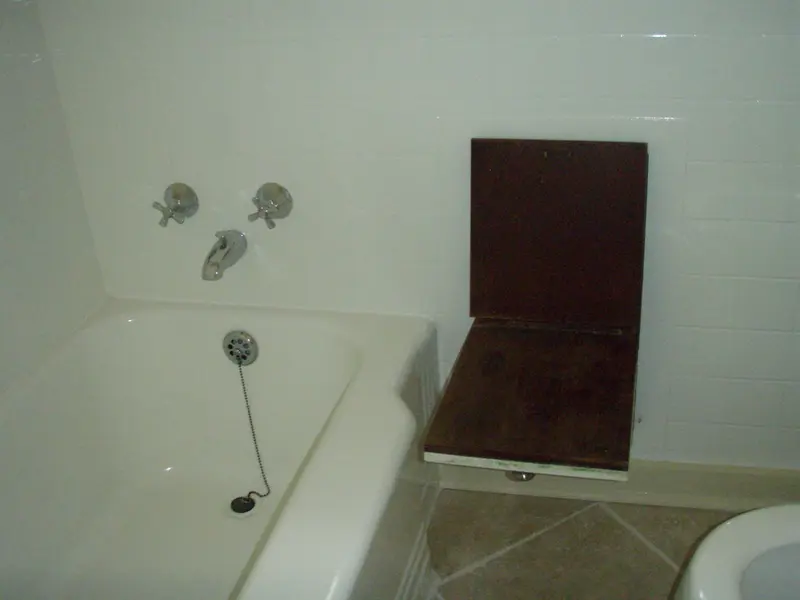
- Wall-mounted fold-down shower seatShower seats, stools and chairs
A seat fixed to the shower wall that folds up out of the way when you do not need it.
What each aid is and what to check before buying is on our bathroom aids page. We do not test or rate products. An occupational therapist can tell you which aids are safe for you.
Why an assessment may be the better present
The NHS says a needs assessment from the council is free and anyone can ask for one. An occupational therapist looks at how the person manages washing and other daily tasks.
In England, the NHS also says the council should pay for each adaptation that costs less than £1,000, and usually pays for small changes such as grab rails. So the "gift" of helping someone ask for an assessment may be worth more than any item — and it gets the right equipment in the right place. Our guide to free equipment and small adaptations explains the rules in each part of the UK.
If you want to know what's available before you speak to anyone, Living Made Easy (opens another website) describes itself as offering impartial advice on aids for independent living, including a directory of equipment and its AskSARA self-help tool.
A note on VAT
VAT rules for mobility aids are specific:
- Over 60? GOV.UK says you pay a reduced 5% VAT rate on certain mobility aids — such as grab rails, bath lifts and built-in shower seats — but only when they are supplied and installed in a private home. Buying the item without having it installed doesn't qualify. The person must be over 60 when it is supplied or installed, and they (or someone for them) sign a declaration for the supplier. GOV.UK says a friend, relative, council or charity can buy it for them.
- Disabled people or people with a long-term illness, of any age, may be able to buy qualifying products for their own personal or domestic use without VAT, GOV.UK says. That is a separate relief with its own rules, and people who are older but not disabled don't qualify for it.
Both are explained in our guide to VAT relief on bathroom adaptations.
Giving it gracefully
A bathroom aid can feel like a comment on someone's abilities. It may go down better as an offer than a surprise: "I saw these and wondered if one might help — shall I keep the receipt?" And if the person would rather not, that's their choice.
For more ideas on raising the subject, see our article on visiting an older relative at Christmas.
Sources we checked
- NHS: Home adaptations (reviewed 12 December 2025) (opens another website)
- NHS: Getting a needs assessment (reviewed 22 August 2024) (opens another website)
- GOV.UK: Mobility aids — reduced VAT if you're over 60 (opens another website)
- GOV.UK: VAT relief for disabled people (opens another website)
- Living Made Easy (opens another website)
- Electrical Safety First: Electrical safety in the bathroom (opens another website)
Checked 22 November 2026. Rules, amounts and phone numbers can change, so please check with the organisation before you rely on them.
Get an assessment first
An occupational therapist (OT) can visit you at home and recommend what is safe and suitable for you. Ask your council’s adult social care team — in Northern Ireland, your Health and Social Care Trust.
This article is general information, not medical, financial or legal advice. Everyone’s needs are different. Speak to an occupational therapist, your GP or the organisations we link to before making decisions.